
In Mary Shelley’s Frankenstein, Victor Frankenstein states that “if the study to which you apply yourself has a tendency to weaken your affections, and to destroy your taste for those simple pleasures in which no alloy can possibly mix, then the study is certainly unlawful” (50). The consequences that arise from Frankenstein’s statement have similarities to that of William Godwin’s Of the Causes of War, which follows Godwin’s stance on war. Frankenstein’s statement relates to his ambition to work and how it would later lead to bad consequences. Godwin gives the reader his view on war and its consequences. There are some parallels with the consequences in their topics, but Godwin also has some similarities with his view on war.
In Mary Shelley’s Frankenstein, Victor Frankenstein states that “a human being in perfection ought always to preserve a calm and peaceful mind, and to never allow passion or a transitory desire to disturb his tranquility” (49-50). The statement he presents refers to himself because he is the “human” who is not allowing “passion or a transitory desire” to disturb the “tranquility” in his work. The reader sees this when his father makes a remark regarding his absence from the world and how he has neglected his other duties. Victor Frankenstein’s statement towards preserving a peaceful mind relates to one of William Godwin’s statements in Of the Causes of War, in which he states that “society was instituted, not for the sake of glory, not to furnish splendid materials for the page of history, but for the benefit of its members” (743). Godwin mentions that society was not put in place for the “sake of glory”, but for the members of it. Both statements relate to one another because they both say that letting the desires and urges for fame disturb the overall process of the work. In Godwin’s case, its society that would be disturbed if desire and fame were the motives for instituting it. The consequence that rises from Victor Frankenstein’s work is a turning point for him because he realizes that desire for becoming well known caused someone else pains. Just like Godwins said, wanting to win a war causes the deaths of many others.
William Godwin contributes to Mary Shelleys, Victor Frankenstein, by stating that “individuals were liable to error, and suffered their apprehensions of justice to be perverted by a bias in favour of themselves, government was instituted” (744). Godwin is saying that people will be subjected to error and to things that play in their own favor. He goes on to mention how “nations were susceptible of a similar weakness” and how this “weakness” lead to the introduction of war (744). This leads to the notion of war and how “men were induced deliberately to seek each other’s lives” to “prove successful in devastation and murder” (744). He mentions how war works by mentioning how “men” were destroying one another to prove victory. He describes how “men deliberately destroy each other by thousands without any resentment against or even knowledge of each other” (744). The reader gets a sense of disbelieve and dislike from Godwin because of how he mentions the one reason for war. He thinks “it would be despicable to mention, along with these scenes of honor” because he believes that the real cause of war does not come from dislike, but “in the form of taxes” (744). These are imposed by the “auditors and spectators”, who are at “distance from the scene” (744).
Frankensteins’ statement about “unlawful pursuit” (50) gives the reader a glimpse of how things might play out because of how he is approaching his own study. The consequences that arise from this situation led him to understand that his desire for becoming well known had caused everything. Godwin gives his stance on war, which is that he believes that men slaughtering themselves not knowing one another for a victory. There are parallels with the consequences of Frankensteins’ statement and Godwin’s stance on war. Both mention how a situation has led to a series of consequences that were built on the belief that one’s desire to be successful, but facing the consequences because of one’s desire. Both focus on how the desire to either win a war or to become known for their work can lead to a consequence where either they or someone else is negatively affected.
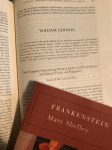
Work Cited
Godwin, William. From “Of the Causes of War.” The Norton Anthology of British Literature: The Romantic Period. 10th ed. Stephen Greenblatt, General Editor. W. W. Norton, 2017. pp. 743-44.
Shelley, Mary. Frankenstein. Introduction and Notes by Karen Karbiener. Barnes and Noble, 2003.
 Roberto's Blog
Roberto, “Victor Frankenstein’s Unlawful Pursuits and William Godwin’s Stance on War” presents a thoughtful comparative study of Godwin’s Of the Causes of War and Victor’s observations in Chapter 4 of Frankenstein. Eliminating repetition and correcting errors of punctuation would strengthen the essay.
LikeLike
Roberto, “Victor Frankenstein’s Unlawful Pursuits and William Godwin’s Stance on War” is a well thought out analysis comparing Mary Shelley’s “Frankenstein” and her father’s “Of the Causes of War”. You make a good point in discussing the theme of ambition and its negative tolls on society and those we hold dear. Refraining from using so many quotations and fixing minor grammar errors will make this essay even stronger and more coherent.
LikeLike