
The Victorian Age. 10th ed. Stephen Greenblatt, General Editor. W. W. Norton, 2017. C2.
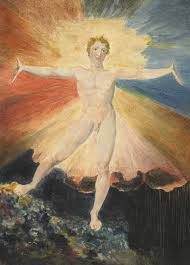
At first glance of William Blake’s painting Glad Day, or The Dance of Albion introduces this light shining from behind the figure, making him seem radiant and astonishing. The light shining from behind creates this feeling of empowerment. The painting conveys a man embracing the world with joy and the nudity symbolizes how the truth of what is happening is out in the open now. The title of the painting gives a closer look at what the artist is trying to convey when he painted it. William Blake identifies the figure in the painting as Albion, which represents the “ancient form of Britain” (C2). William Blake describes the story behind him, which is that he has “fallen on evil, repressive times but is destined to awake and to unite all people”(C2). The painting reminds me of how Jesus rose from the dead to help guide the people to a life of good.
The poem Visions by William Blake introduces the reader to the daughters of Albion, which are enslaved but not physically but their minds are. The poem is a story about women and how she was raped, but back then rape was not considered bad. The poem mentions how women were merely seen as nothing back then. In the poem, William Blake mentions in his poem that “the daughters of Albion hear her woes, and echo back her sighs” is saying that women were not being heard and they would sigh back for they were ignored (158). The poem connects to the painting because of Albion and how he is the one who is supposed to free the people politically and spiritually. The poem shows what type of attitudes people had toward women and how they needed someone to step up for them. They would cry out loud but no one would hear their cries. The poem and painting have a close connection because of how the figure in the painting is the savior to the women in the poem.
Work Cited
Blake, William. Excerpt from “Visions.” The Norton Anthology of British Literature: The Victorian Age. 10th ed. Stephen Greenblatt, General Editor. W. W. Norton, 2017.p 152.
 Roberto's Blog
Roberto, “Britain, the Liberator of Slaves” offers a thoughtful and detailed examination of the parallels between William Blake’s engraving Glad Day, or The Dance of Albion and lines from his poem “Visions of the Daughters of Albion.” Correcting minor errors of punctuation and style would make this strong post even stronger.
LikeLike